Thoughts
I went looking for a Figma replacement.
Claude Sonnet 5 helped me write this.
We are moving into an age where using AI is just expected in a design workflow. Not optional, not a nice-to-have on a resume. Expected. That expectation is what put me into a phase of obsessively testing every AI tool that came out, and it left me with two feelings at once that I don't think get said out loud enough.
There was excitement. Genuine excitement, about how much new technology was suddenly out there and how early I got to touch it. And there was a slight fear, too, that if I didn't learn the new tool fast enough, I would fall behind. Both were real. Neither one cancels the other out.
But the testing wasn't random. I was looking for something specific: an AI-native replacement for Figma.
The search
Figma is the tool I use the most. It is where I have lived for years. So the question I kept bringing to every new launch was not "is this a fun tool," it was "could this be the place I live instead."
Most of what I tried didn't survive an evening. I am not going to name those. They weren't great, and the interesting thing about them isn't which ones they were. It's how fast the filter worked. A tool either showed me something real in the first hour or it didn't, and if it didn't, I didn't go back.
Twelve did survive. I loved all twelve, for different reasons, not the same reason repeated twelve times. That matters, because it means there was no winner. Nothing on the list replaced Figma. What I ended up with instead was a stack.
The one with the best shot let me down the most
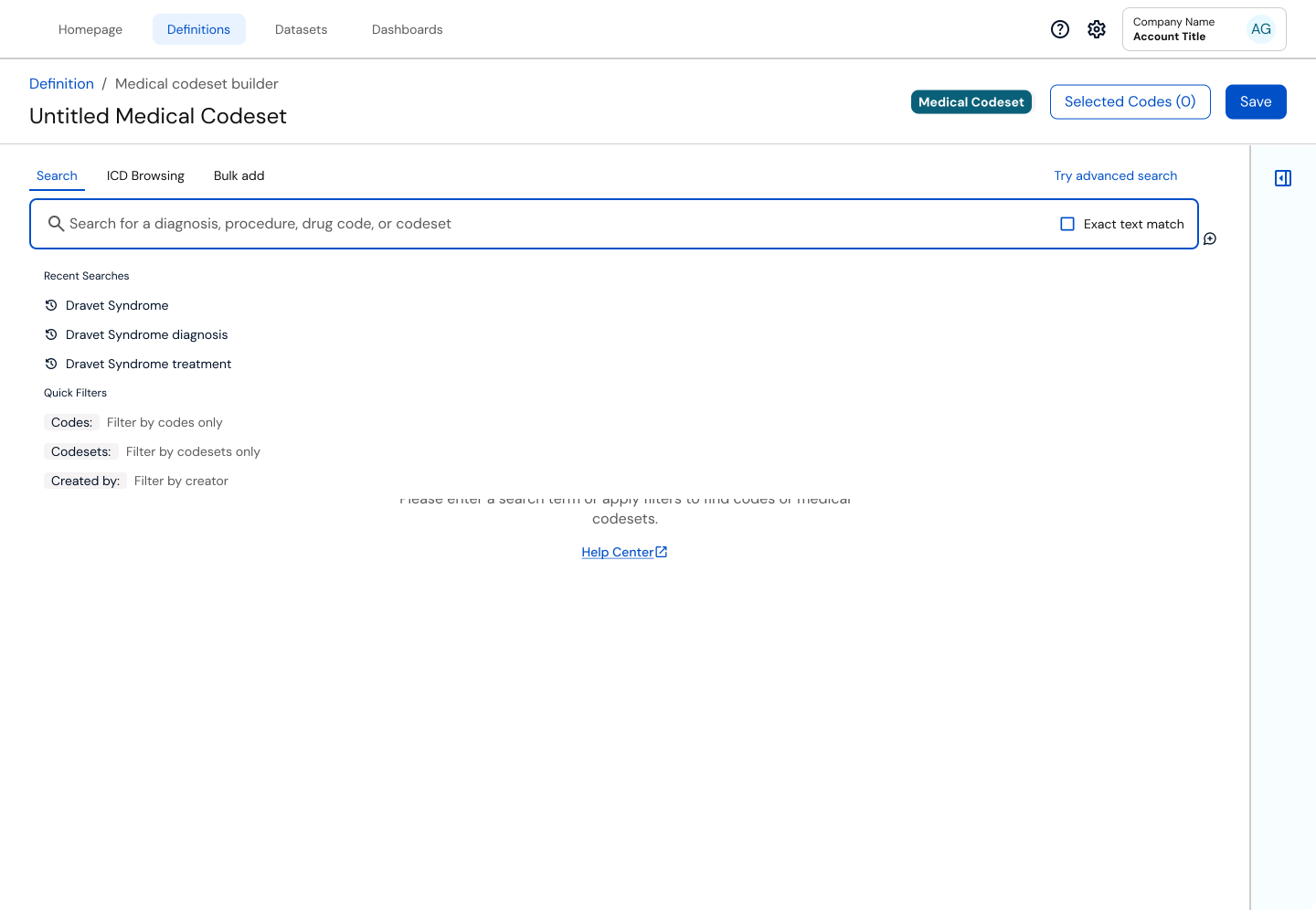
Figma Make is the one I was rooting for hardest, and its updates were the ones I kept hoping would land. Every other tool on my list started from zero. Stitch, Claude Design, all of them. They don't know my components, my variables, my files. When they fail to respect a design system, that's expected. They never had one to begin with.
Figma Make already had it. Same file. Same libraries. Same components I'd built over years. It had the one advantage nothing else on my list could claim, and it's still the one that disappointed me most.
It isn't just a feeling, either. Figma's own community forum confirms the exact failure I kept hitting: components from design system libraries don't reliably export from Figma Make. They can paste back in as plain Figma elements instead of the real thing. The tool with the best possible starting position still couldn't carry my system through cleanly. For their own product to be that disappointment was sad to say the least.
What earned a place, and why
Cursor stuck because of two things together: point-and-click editing, and a noticeably better Figma integration than anything else I tried. It did a better job than the others at translating a vibe-coded prototype back into Figma.
That detail matters more than it looks like at first. I went looking for something to replace Figma. The tool that earned a permanent slot did so by being best at going back to it. Figma never stopped being the destination. It's still the system of record: the place work has to land, get reviewed, get handed off, and live.
So the honest version of my search isn't "nothing was good enough to replace Figma." It's that I built a stack that orbits the thing I was trying to leave. The tools that survived are the ones that talk to Figma well, not the ones that could stand in for it.
Claude Code desktop does the opposite direction well: Figma into code. With the capture link, my designs get translated exactly. It gives me point-and-click modification, multiple terminals, file management in a side panel, and context that actually persists. It's the center of the stack now.
Two different directions, both from tools I kept: my prototype becoming a design file, and my design file becoming a working prototype. I want to keep those separate in my head, because it's easy to blur them into one vague "Figma integration," and they're not the same job.
The tool built for exactly what I wanted
Paper (paper.design) is the one that made me feel like I wasn't crazy for looking. Its canvas is real HTML and CSS, not a proprietary format, and it's built MCP-native from the ground up: an agent can read the canvas and write directly to it, not just generate something new. Some reviewers frame it outright as a Figma challenger.
It's also still in open alpha. Figma is still where the industry actually is. Even Paper's own comparisons concede it: Figma is more mature, has the ecosystem, and is still the default for most teams.
What I keep coming back to is the parallel. Paper rebuilt the canvas from scratch so an agent could act on it directly. I did something smaller with the same instinct. Neither of us thought the answer was a chat window. We both thought the answer was making the surface itself something an agent could touch.
The one I kept, then killed, then understood why
Conductor solved a real problem for me. I was living in the terminal, running Claude Code, and at some point I had what felt like a million terminal windows open. Conductor organized that.
Two things ended it. The model access I had through my subscription only covered Sonnet 4.6 for free. Every Opus tier I could pick was the paid, outside-subscription version, and Opus was the one I actually wanted for harder reasoning.
The second reason is the one I actually think matters more. I was living in the terminal because I assumed the desktop app had worse capabilities. It doesn't. It does the same thing, but with a UI: I can see everything, make point-and-click modifications, and switch between projects from a side nav.
Once I saw that, Conductor's whole reason for existing evaporated. It wasn't a bad tool. It solved a problem I had manufactured for myself by believing something that wasn't true. Claude Code desktop didn't beat Conductor. It made the problem Conductor was solving disappear.
The pattern I didn't notice until I looked back
Point-and-click kept coming up. Cursor, for the editing. Claude Code desktop, for the modification and a side nav where I can see everything. Figma, the one tool that was never displaced, is a canvas before it's anything else.
Every tool that survived lets me point at the thing instead of describing it. I'm a designer. Direct manipulation is the way I actually think, and I'd been selecting for it the whole time without naming it.
The Claude Code move is the cleanest proof of this, because it isolates the variable. Same product, same model, same capabilities. It does the same thing. The only thing that changed was the interface. And that one change was enough to end an entire tool I'd built into my workflow. The tool didn't get better. The interface did.
What none of the twelve have
This is where the search actually failed, and it wasn't about features.
None of the twelve are multiplayer. There's no one else in the file with me, no comment thread, and no history to point to when someone asks why a button ended up the way it did. Every one of them was built for one person and a text box.
| Tool | Point at it | Round-trips to Figma | Own the code | Backend / deploy | Version history | Multiplayer |
|---|---|---|---|---|---|---|
| Stitch | ● | ● | ◐ | ○ | ○ | ○ |
| Paper | ● | ○ | ● | ○ | ○ | ○ |
| Claude Design | ● | ○ | ● | ◐ | ○ | ○ |
| Figma Make | ● | ◐ | ◐ | ◐ | ◐ | ○ |
| V0 | ◐ | ○ | ● | ● | ● | ○ |
| Lovable | ● | ○ | ● | ● | ● | ○ |
| Bubble.io | ● | ○ | ○ | ● | ◐ | ○ |
| FlutterFlow | ● | ○ | ● | ● | ◐ | ○ |
| Cursor | ● | ● | ● | ◐ | ● | ○ |
| Claude Code | ● | ● | ● | ◐ | ● | ○ |
| Antigravity | ◐ | ○ | ● | ◐ | ● | ○ |
| Conductor | ◐ | ○ | ● | ◐ | ● | ○ |
● yes ◐ partial ○ no
Twelve tools, six capabilities. The last column is empty top to bottom.
Design doesn't work that way. It runs on review and disagreement, and on a trail you can walk back months later when nobody remembers the original reasoning.
Figma seems to know this is the gap. At Config 2026 they announced that agent chats are now visible to the whole team by default, so you can see what directions a teammate is exploring and build on it. That's real progress toward collaboration. What Figma hasn't announced is the history and traceability piece: a record of why a decision was made, not just that the AI made one. I think that's what has to come next, not something already shipped.
Nobody on my list has built that piece yet. Not the twelve tools, not Paper, and not Figma.
What I am doing for now
So I built it myself. A small MCP server that reads comments left directly on a Figma file and hands them to Claude, which makes the modifications the comment is asking for.
The workflow is exactly the ordinary thing designers already do all day: leave a comment on a file. Except now the comment is also the prompt. The most mundane gesture in design review became the instruction channel for an agent.
That's the actual ending to a year of testing everything. I went looking for a replacement. I didn't find one. What I found instead is that the last piece (the one that would have made this all feel finished) wasn't for sale anywhere I looked. So I built it, small and specific, for exactly my own workflow.
I made the tool work for me.
Sources
Figma Make export design doesn't export the library components — Figma Community Forum.
Paper Design vs Figma: Two Different Bets on the Future of Design — Katharina Pilz.
Config 2026: New Materials, New Tools and a More Expressive Canvas — Figma Blog.
Keep reading